
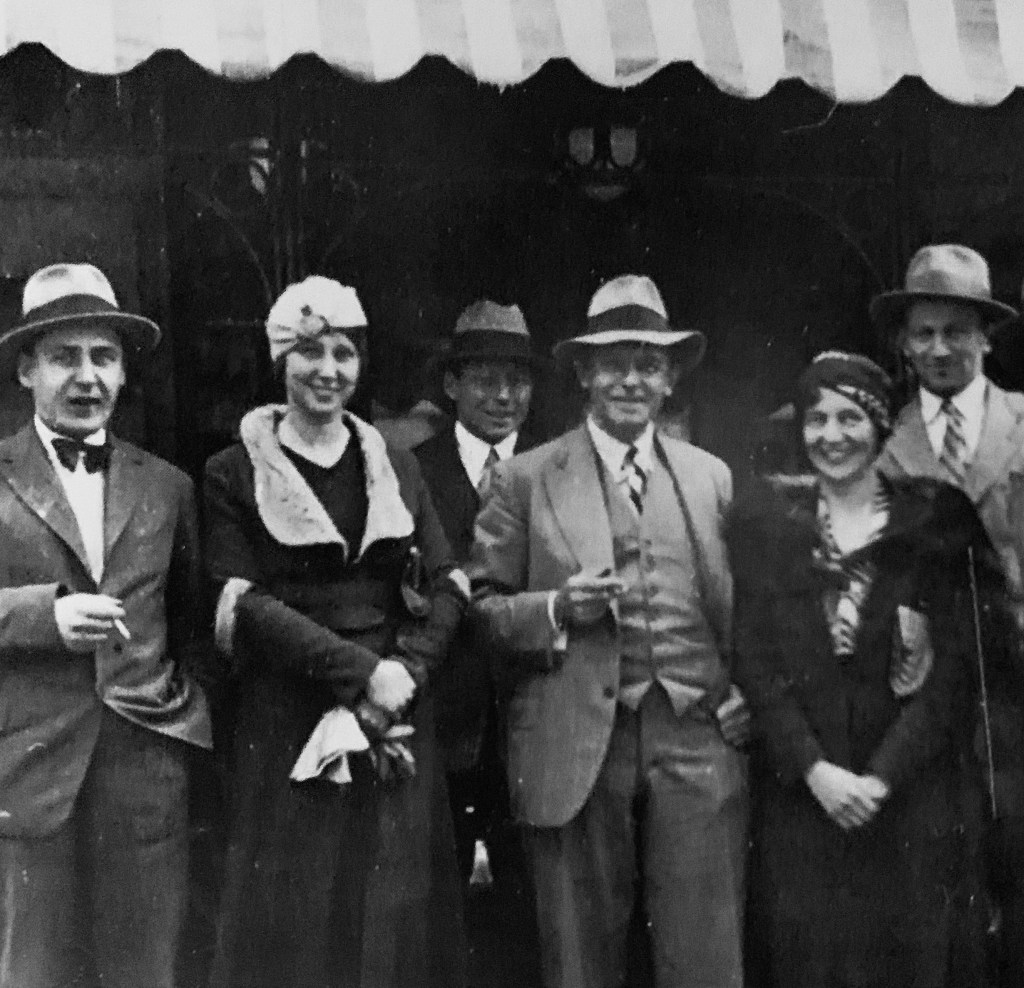
The founder of modern soil mechanics
October 2023 marks the anniversary of two important dates: 140 years ago, Karl von Terzaghi, the founder of modern soil mechanics, was born in Prague on October 2, 1883, and 60 years ago Terzaghi died in Winchester (Massachusetts) on October 25, 1963. There are 80 impressive years in between.
Karl von Terzaghi is rightly considered the founder of modern soil mechanics. Heinz Brandl writes about Terzaghi’s work: „Today, no significant foundation projects or earthworks are planned and carried out without the science he created,“ which more than clearly sums up his life’s work.
The beginnings
Karl von Terzaghi was born in 1883 into an officer’s family in Prague. Until 1860, Prague was a predominantly German city. Terzaghi then studied mechanical engineering, geology, philosophy and astronomy at the Graz University of Technology and was a member of the Corps Vandalia Graz, as evidenced by several photographs. The genius of a personality is not formed by the mere fulfillment of academic duties. It is precisely the strolling years that focus on the world across disciplines and make the beauty of things understandable beyond the technical one-sidedness and sometimes pettiness. It is no coincidence that Terzaghi came close to being expelled from the Graz University of Technology for academic negligence.
After graduating from college, Terzaghi joined the Pittel construction company and became a project engineer. After 3 years of work, Terzaghi worked on buildings in Russia and Croatia, where he dealt in depth with geology and groundwater forms. In 1910 he wrote his dissertation in Graz and was in the United States for the first time in 1911 before serving in the Air Force during the First World War alongside well-known figures in fluid mechanics.
Modern soil mechanics
When Terzaghi’s teacher, Philipp Forchheimer, who was a popular engineer in hydraulic engineering, lured Terzaghi to Istanbul in 1916, he followed the call. There Terzaghi became a professor of foundation engineering, road and railway construction and for the first time made the decision to develop a strength theory for soils. To date, the well-known figures in foundation engineering believed that the problems of geotechnical engineering could only be solved through experience and not through mechanical models. Terzaghi strongly disagreed. However, as a member of a defeated nation, Terzaghi lost his teaching position and subsequently took a position at the American Robert College in Istanbul.
In keeping with his intention to develop a strength theory for soils, Terzaghi set up an earthworks laboratory in Istanbul and dealt with the internal erosion of dams on sandy subsoil and with the time setting of structures on clay. Terzaghi discovered the mechanism of clay consolidation, which he then published in the 1925 work “Earth Construction Mechanics on the Basis of Soil Physics”. Consolidation basically refers to the time-delayed compression of soils, which in fine-grained soils such as clays is characterized by the water balance.
In 1925, Terzaghi received a visiting professorship at the Massachusetts Institute of Technology (MIT) in Cambridge. Terzaghi therefore worked as a consultant on numerous large construction sites. Terzaghi’s work was more than controversial. Through his revolutionary approach, he put the established ones in the shade. Every change initially provokes resistance because positions of power are associated with every established order. By acting as a consultant on almost all major projects in North America, Terzaghi was able to test soil mechanics theory efficiently and quickly in construction practice.
In the work “Theoretical Soil Mechanics” Terzaghi [4] writes:
The elastic dimensions of the building materials steel or reinforced concrete change only slightly, and the laws of applied mechanics can be transferred for practical use without restrictions. In contrast, theoretical studies in soil mechanics only represent working hypotheses because our knowledge of the average physical properties of the subsoil and the course of the individual layer boundaries is always imperfect and often extremely inadequate. From a practical point of view, however, the working hypotheses developed in soil mechanics are just as applicable as theoretical strength theory to other branches of civil engineering.
Der Star-Ingenieur

When Terzaghi was appointed to the Vienna University of Technology in 1929, he was able to get academic achievement. The earthwork laboratory in Vienna and the lectures received international attention, so that Vienna „became the intellectual center of all circles interested in soil mechanics around the world“ [1] and attracted followers from all over the world.
Terzaghi established soil mechanics methods such as the triaxial test and dealt with the elastic properties of sands and clays and with the settlement of clay soils. Terzaghi’s principle was to use the simplest possible apparatus because the complexity distracted from the actual laws. An early nod towards today’s three-dimensional, digitized calculation methods.
Terzaghi worked as a consultant in Europe, Africa, North America and Central Asia and was a visiting professor in Berlin-Charlottenburg and Massachusetts. At the Technical University of Berlin, the civil engineer Fritz Todt, who was inspector general for roads in the Third Reich, tried in vain to recruit Terzaghi for a professorship in Germany.
Already back then, Terzaghi emphasized that the problem in geotechnics no longer lay in inadequate calculation methods, but rather in the „effect of geological details that inevitably escape observation“ and have long since become more important than the accuracy of the calculation [1]. This may also be seen as a nod towards modern calculation methods, which are mathematically „correct“, but where every result depends on the quality of the input parameters. Numerous publications followed in Vienna.
Terzaghi’s opponents reacted with strong criticism to the new approaches in soil mechanics and to the calculation of essential mechanical soil properties on the basis of laboratory values. The fact that it was possible to predict the permissible subsoil load using parameters other than pure experience was met with total rejection. According to the critics, a “good tree root” is capable of achieving more than any shear and friction coefficient determined in the laboratory.
America
In 1938, Terzaghi was supposed to move to the United States for personal and not political reasons, as the biographers emphasize. Terzaghi’s wife was American. There are also career-related considerations. From 1939, Terzaghi was employed at Harvard as a professor of soil mechanics and created numerous publications and standard works of international renown. Terzaghi dealt with earth dams, dams, landslides, foundations, bridges, industrial buildings, hydraulic structures, airports, adit and tunnel construction and subways. Terzaghi received the highest honors for his work in establishing soil mechanics.
Heinz Brandl writes about his life’s work: „He condemned the application of theory without observation of nature and without equivalent practical experience and was a constant role model in this regard: Just as he was able to spend nights immersed in theoretical problems, he was equally often on construction sites and shied away until old age no physical exertion“ [1].
And further: „As the founder of a new branch of technical science, he always tried to provide the appropriate training for the next generation and the training of young engineers, whom he carried along with his professional enthusiasm. His lectures, presentations and discussions were usually seasoned with refreshing humor could also turn into biting humor. In addition to his eloquence, he was also characterized by a literary and graphic talent and a general interest that only the greats possess. Already during his lifetime, Terzaghi represented such a capacity that even back then many considered him to be the greatest civil engineer in this area century“.
Literatur:
[1] Heinz Brandl: „100 Jahre Karl v. Terzaghi“, Mitteilungen für Grundbau, Bodenmechanik und Felsbau, Technische Universität Wien, Heft 2 1983
[2] Heinz Brandl: „Die Geschichte des Instituts für Grundbau und Bodenmechanik der Technischen Universität Wien“, Mitteilungen für Grundbau, Bodenmechanik und Felsbau, Technische Universität Wien, Heft 2 1983
[3] Heinz Brandl: „Vom Grundbau zur Bodenmechanik – von der Bodenmechanik zur Geotechnik“, Tagungsband zur 2. Deutschen Bodenmechanik Tagung Bochum, Springer-Verlag Berlin Heidelberg 2015
[4] Karl von Terzaghi: „Theoretische Bodenmechanik“, Springer Verlag, Berlin / Göttingen / Heidelberg 1954
Image credit: Wikipedia, public domain (protection period expired)
 Demanega
Hinterlasse einen Kommentar